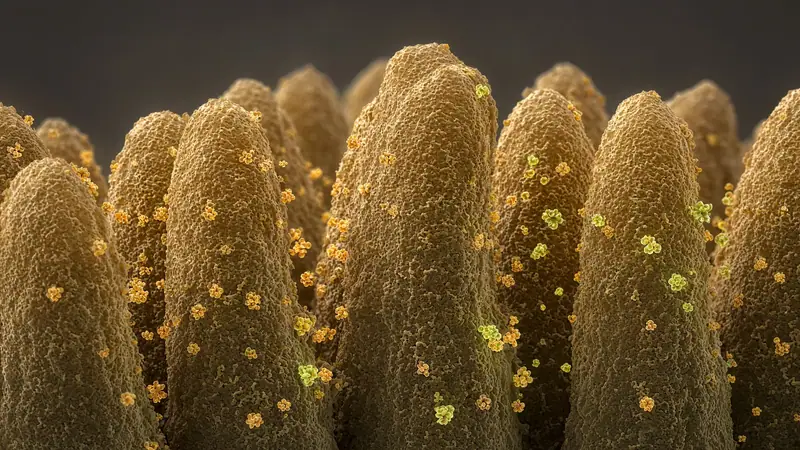
This case study summarizes our paper in Veterinary Sciences (2025), volume 12, article 884, open access under CC BY 4.0. Read the full paper: https://doi.org/10.3390/vetsci12090884
Highlights
- Heifers
- 29female fetuses, 2 × 2 design
- Sugar transporters
- 5measured in villi and crypts
- Villus height
- +7.95%restricted vs control (P = 0.005)
- Fetal jejunum sampled
- Day 161treatments ran days 0–63
- Fetuses from heifers that lost weight in early pregnancy had 7.95% taller villi in the jejunum, which enlarges the surface that absorbs nutrients.
- Restricted heifers given one-carbon metabolites (OCM) carried fetuses with the deepest crypts and the thickest gut muscle layers.
- OCM lowered several sugar transporters in the crypts and raised others in the villi, shifting them toward the absorbing surface.
- To the authors’ knowledge, this is the first study to measure muscle layer thickness in the bovine fetal small intestine.
Methodology
Part of the starch a cow eats escapes the rumen and is digested in the small intestine, where glucose and other sugars are absorbed by transporter proteins. How well the gut absorbs sugars depends on those transporters and on the gut's shape: villus height sets the absorbing surface, and the muscle layers move contents along. This study asked whether the dam's diet in early pregnancy, with or without one-carbon metabolites, changes both in the fetal jejunum.
The four treatment groups
CON −OCM
- Actual gain
- 0.72 kg/day
- Supplement
- Corn carrier, saline injections
CON +OCM
- Actual gain
- 0.65 kg/day
- Supplement
- One-carbon metabolites
RES −OCM
- Actual gain
- −0.13 kg/day
- Supplement
- Corn carrier, saline injections
RES +OCM
- Actual gain
- −0.14 kg/day
- Supplement
- One-carbon metabolites
The OCM supplement was rumen-protected methionine (7.4 g/day) and choline (44.4 g/day) with weekly injections of vitamin B12 (20 mg) and folic acid (320 mg). Treatments ran from breeding to day 63; after that, all heifers ate the same diet until day 161.
The five transporters and what they carry
SLC5A1
- Carries
- Glucose and galactose, with sodium
SLC2A2
- Carries
- Glucose out of gut cells into blood
SLC2A5
- Carries
- Fructose from the gut lumen
SLC2A1
- Carries
- Glucose from blood into tissue; mainly in capillaries
SLC2A3
- Carries
- Glucose for cells that need rapid bursts of energy
From fetal jejunum to measurements
- Day 161 ± 1 Jejunum collected Same location in every fetus
- Staining Fluorescent antibodies One antibody per transporter
- Imaging Whole cross-sections Villi and crypts imaged separately
- Statistics Mixed model Diet × OCM, Tukey–Kramer comparisons
Results
Restriction raised villus height on its own (P = 0.005). Crypt depth depended on both treatments together (P = 0.02): it was greatest in the RES +OCM group.
Villus height
Total muscle layer thickness
Both the inner circular and outer longitudinal muscle layers tended to be thicker in the RES +OCM group (P = 0.08 and 0.06 for the interaction).
The transporters gave a consistent pattern. With OCM, abundance fell in the crypts for four transporters and rose in the villi for three:
Where one-carbon metabolites moved the transporters
Less in the crypts
- Transporters
- SLC2A1, SLC2A3, SLC2A5 (−24%), SLC5A1
More in the villi
- Transporters
- SLC2A2, SLC2A5, SLC5A1
SLC5A1 in the villi
Other results by transporter: OCM lowered SLC2A1 in the villi (15.11 vs 10.96) and in the whole section; SLC2A3 tended to be higher with restriction (P = 0.08); SLC2A2 was lower in the RES −OCM group than in CON −OCM; and fructose transporter SLC2A5 in the villi was highest in the RES +OCM group.
Discussion
Taller villi under restriction look like an adaptation that enlarges the absorbing surface when the dam supplies less. It fits the earlier finding, in our fetal gut vascularity study of the same experiment, of more capillary area and cell density in the villi of restricted fetuses. Higher SLC2A3 in restricted fetuses may likewise help them take up glucose when it is scarce; restricted heifers in earlier work from the lab had less glucose in the fetal fluids.
For OCM, the authors see programming toward efficiency. Lower SLC2A1 may mean the tissue relies less on high-affinity glucose uptake, and OCM appeared to keep SLC2A2 from falling in restricted fetuses. The fructose result matters because fructose is a major sugar in the fetal fluids of hoofed animals. Taken together, moving transporters from the crypts to the villi, where absorption happens, may be the fetus adapting under OCM, possibly through DNA methylation.
The limits are clear in the paper. Transporter abundance was measured by staining, not by absorption tests or Western blotting; epigenetic changes were not measured directly; only female fetuses were studied; and thicker muscle layers may raise the gut's own energy and oxygen needs. Related work with the same design and sampling day is in our fetal mitochondria case study.
The paper expands a conference abstract in the Journal of Animal Science (2025) that reported the SLC2A1 and SLC2A3 (GLUT1 and GLUT3) results.
Conclusion
- Maternal restriction in the first 63 days increased fetal villus height at day 161.
- OCM given to restricted heifers produced deeper crypts and thicker muscle layers in the fetal jejunum.
- OCM shifted hexose transporters from the crypts toward the villi, which may help the fetus absorb nutrients more efficiently.
Key References
- Daneshi M, Borowicz PP, Entzie YL, Syring JG, King LE, Safain KS, Anas M, Reynolds LP, Ward AK, Dahlen CR, Crouse MS, Caton JS (2024). Influence of maternal nutrition and one-carbon metabolites supplementation during early pregnancy on bovine fetal small intestine vascularity and cell proliferation. Veterinary Sciences, 11, 146. https://doi.org/10.3390/vetsci11040146
- Daneshi M, Borowicz PP, Hirchert MR, Entzie YL, Syring JG, King LE, Safain KS, Anas M, Reynolds LP, Ward AK, Dahlen CR, Crouse MS, Caton JS (2024). Influence of maternal nutrition and one-carbon metabolites supplementation on bovine antimicrobial peptides in fetal and maternal tissues. Frontiers in Veterinary Science, 11, 1505427. https://doi.org/10.3389/fvets.2024.1505427
- Meyer AM, Caton JS (2016). Role of the small intestine in developmental programming: impact of maternal nutrition on the dam and offspring. Advances in Nutrition, 7, 169–178. https://doi.org/10.3945/an.115.010405
- Koepsell H (2020). Glucose transporters in the small intestine in health and disease. Pflügers Archiv – European Journal of Physiology, 472, 1207–1248. https://doi.org/10.1007/s00424-020-02439-5
- Crouse MS, Greseth NP, McLean KJ, Crosswhite MR, Pereira NN, Ward AK, Reynolds LP, Dahlen CR, Neville BW, Borowicz PP, Caton JS (2019). Maternal nutrition and stage of early pregnancy in beef heifers: impacts on hexose and AA concentrations in maternal and fetal fluids. Journal of Animal Science, 97, 1296–1316. https://doi.org/10.1093/jas/skz013