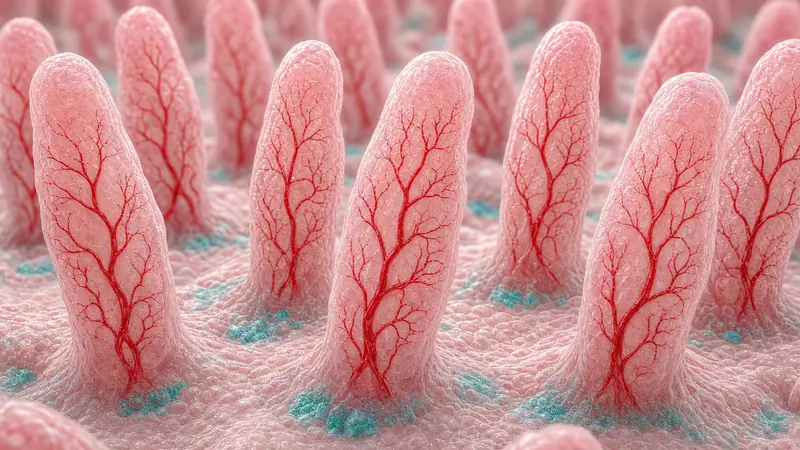
This case study summarizes our paper in Veterinary Sciences (2024), volume 11, article 146, open access under CC BY 4.0. Read the full paper: https://doi.org/10.3390/vetsci11040146
Highlights
- Heifers
- 29female fetuses, 2 × 2 design
- Fetal jejunum sampled
- Day 161treatments ran days 0–63
- Capillary area in villi
- +16%restricted vs control (P = 0.05)
- Small intestine weight
- −7 gwith one-carbon metabolites (P = 0.02)
- Fetuses from heifers fed to lose weight in early pregnancy had 16% more capillary area in the villi of the jejunum at day 161.
- One-carbon metabolite (OCM) supplements made the fetal small intestine lighter (64.08 vs 71.08 g) and lowered cell proliferation.
- The growth-factor receptor VEGFR2 tended to be higher in the villi with OCM, but restriction did not change it, so it probably did not drive the extra capillaries.
- The authors read the OCM effects as more efficient growth, not impaired growth.
Methodology
The small intestine absorbs the nutrients that drive a calf's growth, and its blood supply sets how much it can take up. Earlier work showed that the dam's diet can change the fetal gut. This study asked whether restricting the dam's intake in the first two months changes the vessels and cell growth in the fetal jejunum, and whether one-carbon metabolites, nutrients that donate methyl groups for epigenetic regulation, can offset it.
The four treatment groups
CON −OCM
- Supplement
- Corn carrier and weekly saline injections
CON +OCM
- Supplement
- One-carbon metabolites (below)
RES −OCM
- Supplement
- Corn carrier and weekly saline injections
RES +OCM
- Supplement
- One-carbon metabolites (below)
The supplement was rumen-protected methionine (7.4 g/day) and choline (44.4 g/day) in a corn carrier, plus weekly injections of vitamin B12 (20 mg) and folic acid (320 mg). Control heifers actually gained 0.60 kg/day and restricted heifers lost 0.23 kg/day.
Study timeline
- Breeding Treatments start Female-sexed semen from a single sire
- Day 0–63 Diet and OCM Four treatment groups
- Day 63–161 Common diet All heifers target 0.45 kg/day
- Day 161 Fetal jejunum collected 29 female fetuses; male fetuses excluded
- Imaging Fluorescent staining Villi and crypts measured separately
Three things were stained and measured in the villi (the finger-like projections that absorb nutrients) and the crypts (the pits between them, where new cells form):
What was measured
Capillaries
- Measures
- Capillary area density and capillary number density
Vessel growth signal
- Measures
- Share of cells responsive to VEGF
Cell proliferation
- Measures
- Share of dividing cells and cell density
Results
Restriction did not change small intestine weight (P = 0.17), but OCM supplementation lowered it in both control and restricted heifers (P = 0.02), with no interaction.
Fetal small intestine weight at day 161
In the villi, capillary area density was 16% higher in fetuses from restricted heifers (5.47% vs 4.72% of tissue area). Crypts and the total area did not differ. VEGFR2 tended to be higher in the villi with OCM (P = 0.08) and was lower in the crypts with restriction (P = 0.05).
Dividing cells in the whole jejunal section
Both restriction and OCM lowered the share of dividing cells, and restriction raised spatial cell density (5.1 vs 4.79). In the villi, the RES +OCM group had fewer dividing cells than RES −OCM (P = 0.02).
What each treatment changed
Restricted vs control
- Intestine weight
- No change
- Villus capillary area
- Up 16%
- Crypt VEGFR2
- Lower
- Cell density
- Higher
With vs without OCM
- Intestine weight
- Lower (64.1 vs 71.1 g)
- Villus VEGFR2
- Tended higher
- Dividing cells
- Lower
Discussion
More capillaries in the villi of restricted fetuses match an earlier cattle study and look like a compensating response that keeps nutrients and oxygen flowing to the growing gut; sheep studies found the opposite. Because restriction did not raise VEGFR2, the authors suggest other growth factors produced the extra vessels. In earlier work from the same lab, restricted pregnant heifers had higher serum homocysteine, which reduces the expression of VEGF and its receptors.
The OCM effects need careful reading. A lighter intestine and fewer dividing cells could look like a problem, but the authors argue for efficiency: OCM improved growth and mitochondrial efficiency of bovine embryonic cells in culture. The tendency for higher VEGFR2 in the villi, the region that absorbs nutrients, may support the vessel beds as pregnancy continues.
The same treatments and sampling day were used in our fetal mitochondria case study, and the follow-up on gut structure and sugar transporters is in our fetal jejunum transporter study. Limits: only female fetuses were studied, all at one stage (day 161), and the authors call for longer follow-up of the offspring.
Early results from this work were presented as a poster abstract in the Journal of Animal Science (2023).
Conclusion
- Maternal restriction in the first 63 days increased capillary area in the fetal jejunal villi at day 161.
- VEGF and its receptor probably did not drive that increase.
- OCM supplementation reduced small intestine weight and cell turnover, which the authors interpret as more efficient intestinal growth.
Key References
- Anas M, Diniz WJS, Menezes ACB, Reynolds LP, Caton JS, Dahlen CR, Ward AK (2023). Maternal mineral nutrition regulates fetal genomic programming in cattle: a review. Metabolites, 13, 593. https://doi.org/10.3390/metabo13050593
- Meyer AM, Reed JJ, Vonnahme KA, Soto-Navarro SA, Reynolds LP, Ford SP, Hess BW, Caton JS (2010). Effects of stage of gestation and nutrient restriction during early to mid-gestation on maternal and fetal visceral organ mass and indices of jejunal growth and vascularity in beef cows. Journal of Animal Science, 88, 2410–2424. https://doi.org/10.2527/jas.2009-2220
- Meyer AM, Caton JS (2016). Role of the small intestine in developmental programming: impact of maternal nutrition on the dam and offspring. Advances in Nutrition, 7, 169–178. https://doi.org/10.3945/an.115.010405
- Caton JS, Crouse MS, McLean KJ, Dahlen CR, Ward AK, Cushman RA, Grazul-Bilska AT, Neville BW, Borowicz PP, Reynolds LP (2020). Maternal periconceptual nutrition, early pregnancy, and developmental outcomes in beef cattle. Journal of Animal Science, 98, skaa358. https://doi.org/10.1093/jas/skaa358
- Crouse MS, Caton JS, Menezes ACB, Reynolds LP, Dahlen CR, Borowicz PP, Ward AK (2019). One-carbon metabolite supplementation improves growth of bovine embryonic fibroblasts cultured in divergent glucose media. Translational Animal Science, 3, 1705–1709. https://doi.org/10.1093/tas/txz062