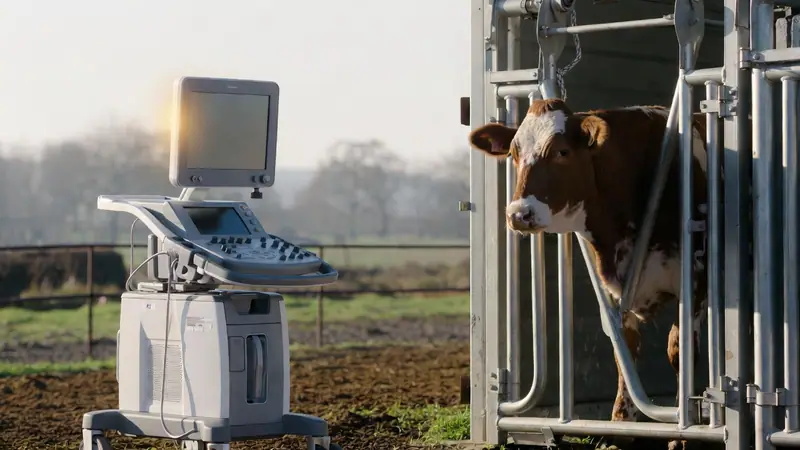
This case study explains our conference abstract in the Journal of Animal Science, volume 100, supplement 2 (2022), pages 12–13. Read the abstract: https://doi.org/10.1093/jas/skac064.019
Highlights
- Heifers
- 295admixed beef heifers
- Age at scan
- ~13 motransrectal ultrasound
- SNPs analyzed
- 116,133per heifer, after quality control
- Genes found
- 2 vs 11Method 1 vs Method 2
- Ultrasound measurements of the reproductive tract were combined into one latent trait, called OVARY, built from total antral follicle count and the diameter of the left and right ovary.
- Two Bayesian GWAS methods were run on the same heifers and the same SNPs. They differed mainly in how they handled population structure.
- Method 1 linked 2 genes to OVARY, including SMYD2. Method 2 linked 11 genes, and 8 of them sit in reproductive pathways.
- The authors concluded that Method 2 is the better choice for selecting admixed beef heifers for reproductive traits.
Methodology
Reproductive performance in heifers is a key indicator of herd productivity, so the study looked for genetic markers and genes tied to the reproductive tract. Each heifer was scanned once by transrectal ultrasound at about 13 months old. The scans recorded antral follicle counts (by follicle size, by side and in total), the length, height and diameter of each ovary, and the diameter of the uterine horn.
Those measurements were not analyzed one by one. Exploratory factor analysis looked for measurements that varied together, and three of them did: total antral follicle count, left ovary diameter and right ovary diameter. Together they formed one latent variable, OVARY. Confirmatory factor analysis then gave every heifer an OVARY score, and that score became the trait for the genome-wide association study (GWAS).
From ultrasound scan to candidate genes
- Animals 295 admixed beef heifers Scanned by transrectal ultrasound at about 13 months
- Measures Follicles, ovaries, uterus Antral follicle counts, ovary length, height and diameter, uterine horn diameter
- Factor analysis One latent trait: OVARY Total antral follicle count + left and right ovary diameter
- Genotypes 116,133 SNPs per heifer Left after quality control
- GWAS Two Bayesian methods Marker windows tested against OVARY
- Genes Windows with PPAW > 0.75 SNPs mapped to the nearest gene, then enrichment analysis
Both methods tested windows of markers rather than single SNPs. The difference was in how they dealt with population structure, which matters in an admixed herd where heifers carry different mixes of breeds.
The two Bayesian approaches
Empirical Bayesian
- Population structure
- Adjusted for as nested structure, using marker frequency differences
- Test unit
- Marker windows, one trait (OVARY)
2 associated genes
MCMC Bayesian
- Population structure
- Fitted as a fixed effect
- Model
- Estimates the fraction of SNPs to include
11 associated genes
In both analyses, windows with a posterior probability of association (PPAW) above 0.75 were kept. SNPs with high genetic variance inside those windows were mapped to their closest gene, and the genes went into enrichment analysis against pathways and Gene Ontology (GO) terms, with significance set at an adjusted P below 0.05.
Results
Genes associated with OVARY, by method
Method 1 found 2 genes. Enrichment analysis singled out SMYD2, which appears in epigenetic and transcriptional regulatory pathways and GO terms.
Method 2 found 11 genes associated with OVARY. The abstract groups them by function rather than listing them by name.
What the 11 Method 2 genes do
- 8 of 11 genes · reproduction and growth reproductive hormone signaling · post-natal growth · sex determination and reproductive organ development · embryo implantation · signal transduction
- 3 of 11 genes · other tissue functions neural transduction · cornification · epithelial integrity · adipogenic (fat cell) pathways
Discussion
The same heifers, the same OVARY trait and the same SNPs gave 2 genes under one method and 11 under the other. Method 2 fitted population structure as a fixed effect and let the model estimate how many SNPs carry an effect. Most of the genes it returned are tied to reproductive hormone signaling, organ development and embryo implantation, which fits a trait built from follicle counts and ovary size.
Grouping several ultrasound measurements into a single latent trait also gave each heifer one score to analyze instead of a dozen correlated numbers. The same idea, factor analysis to build latent traits before running a GWAS, is behind our 2026 Frontiers in Genetics GWAS of body size, reproductive and carcass traits, which extends it to body size and carcass measures.
As a conference abstract, this work reports summary results only. It does not name the 11 genes, give effect sizes, or test the findings in a second population.
Conclusion
- Total antral follicle count and left and right ovary diameter grouped into one latent trait, OVARY, which worked as a single GWAS phenotype.
- The choice of Bayesian method changed the result from 2 to 11 associated genes.
- Method 2, with population structure as a fixed effect, gave the clearer reproductive signal and is the approach the authors recommend for selecting admixed beef heifers.