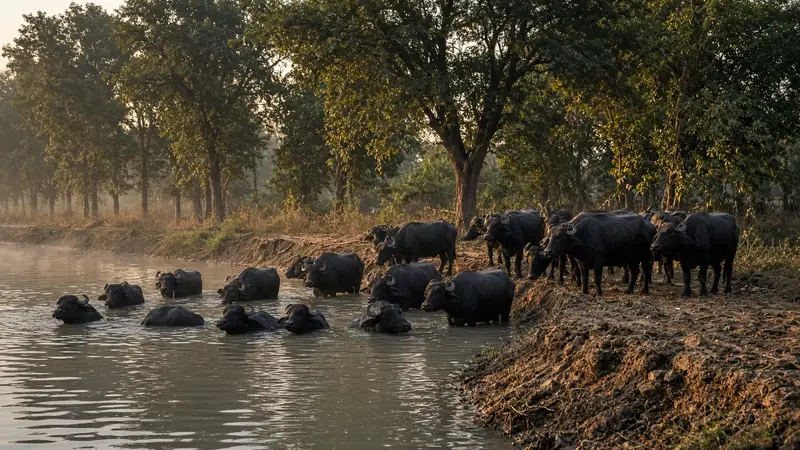
This case study summarizes our published work in Animals (2023), volume 13, article 2543, open access under CC BY 4.0. Read the full paper: https://doi.org/10.3390/ani13152543
Highlights
- Buffalo genomes
- 228Pakistan and 13 other countries
- SNPs per animal
- 34.7 M34,671,886 variants
- Pakistani breeds
- 4Nili, Nili–Ravi, Azakheli, Kundi
- Breed-specific markers
- 4,212across the four breeds
- A new pipeline compares the alleles each breed carries at the same SNP position, instead of only checking whether a SNP position is present in one breed and absent in another.
- It found 1,918 breed-specific markers for Nili, 1,549 for Nili–Ravi, 404 for Azakheli and 341 for Kundi.
- Body measurements could not reliably separate Nili from Nili–Ravi, but PCA, admixture and linkage disequilibrium analyses could.
- The Nili breed, thought to have been lost when Nili–Ravi was developed, still holds a distinct breed status. Farmer families in Pakpattan and Okara have kept it and selected it for production.
Methodology
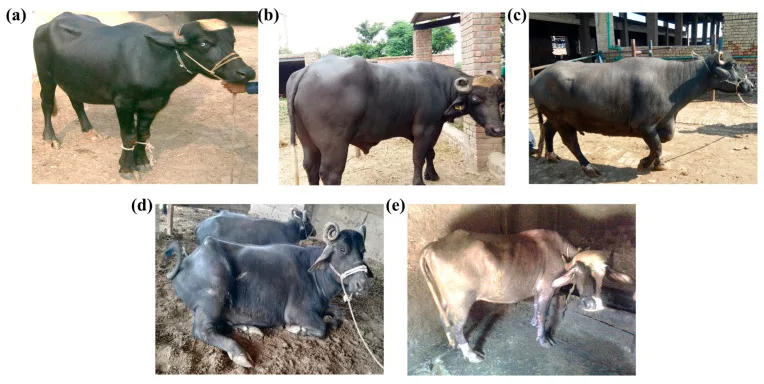
Pakistan has the second-largest buffalo population in the world, and all five of its breeds (Nili, Ravi, Nili–Ravi, Kundi and Azakheli) are river-type buffaloes kept mainly for milk. Telling the breeds apart is harder than it looks. Nili–Ravi is usually recognized by five typical markings known as punj kalyan, but Nili animals can carry the same markings.
Pakistani buffalo breeds
The study combined field measurements with whole-genome data. Body measurements of Nili and Nili–Ravi buffalo were recorded in five areas of Pakistan (Faisalabad, Chichawatni, Pakpattan, Lahore and Qadirabad), following the conformation guidelines of the International Committee for Animal Recording (ICAR) for dairy cattle, because no buffalo-specific guidelines exist. Bulls were scored on 9 traits and females on 11, and live weight was estimated with Schaeffer's formula from body length and heart girth.
The genomic data came from an earlier collaborative study: 228 resequenced buffaloes, 97 river type and 131 swamp type, each with 34,671,886 variants. The Pakistani animals were 4 Nili, 4 Nili–Ravi, 5 Azakheli and 5 Kundi.
From genomes to breed-specific markers
- Data 228 resequenced buffaloes 97 river type, 131 swamp type; 34,671,886 SNPs each
- PCA Clustering by SNP variation All breeds, river type only, then Pakistani breeds only
- Admixture Shared ancestry, k = 2 to 11 How much germplasm the breeds share
- LD decay Uniformity of each breed 0.1 Mb windows (PopLDdecay)
- Markers Allele-based comparison Custom Perl script against all Pakistani and foreign breeds
- Function Genes and KEGG pathways SnpEff annotation, KOBAS enrichment
The marker step is the new part. A SNP counted as specific to a breed when its genotype allele appeared in every animal of that breed, allowing one exception, and in no other breed in the dataset. The one-animal allowance was used because Nili and Nili–Ravi share a close history, and one Nili and one Kundi sample clustered with Nili–Ravi. The paper also supplies a version of the script without this allowance.
Two ways to look for breed markers
Position-based
- Question asked
- Is a SNP position present in this breed and absent in others?
- Limitation
- Closely related breeds often share the same positions
Allele-based
- Question asked
- At the same position, does this breed carry a different allele?
- Result
- Separates breeds that share positions, such as Nili and Nili–Ravi
Results
Body measurements alone did not separate Nili from Nili–Ravi. Nili bulls had greater stature and body depth than Nili–Ravi bulls, and females differed in heart girth, rump width and rear udder width, but the other traits overlapped. Estimated adult body weights were:
Estimated adult body weight (mean ± SD)
The genomic analyses gave a clearer picture. PCA separated river-type from swamp-type buffaloes, and Italian, Iranian and Iraqi buffaloes from the other river types. Plotted on their own, the four Pakistani breeds formed separate groups, with Nili close to Nili–Ravi. In the admixture analysis, Pakistani breeds separated at k = 11 while still sharing germplasm. Linkage disequilibrium then ranked how uniform each breed is:
From most diverse to most uniform (LD decay, 0.1 Mb windows)
- Kundi fastest LD decay
- Azakheli
- Nili–Ravi
- Nili most extensive LD
Breed-specific markers found per breed
Most markers fell outside genes (intergenic). The genes near them pointed to different pathways in each breed:
What the marker genes point to
Nili
- Pathways
- Energy metabolism; growth (MAPK and TGF-beta signaling); nucleotide and amino acid metabolism
Most uniform breed
Nili–Ravi
- Pathways
- Longevity; growth (MAPK and TGF-beta signaling); nucleotide and amino acid metabolism
Azakheli
- Pathways
- Pathways linked to cancer, which the authors relate to its coat color
Kundi
- Pathways
- Immunity, including glycosaminoglycan (heparan sulfate/heparin) biosynthesis
Most diverse breed
Discussion
Officially, Pakistan's buffalo breeds were Nili–Ravi, Kundi and Azakheli, with Nili and Ravi considered lost during the development of Nili–Ravi. The fieldwork found farmer families in Pakpattan and Okara who had kept Nili animals and continued selecting them for production. Every genomic method in the study, from PCA to LD decay to the marker counts, supported Nili as its own breed, and the most uniform of the four.
The phenotype results show why genomics was needed. With shared punj kalyan markings and overlapping body measurements, Nili and Nili–Ravi are hard to tell apart on phenotype alone. The allele-based markers offer a more accurate check, and the Buffalo Breeders Association has kept records of purebred animals so the markers can be validated on more animals.
The study has clear limits. The genomic groups are small (4 or 5 animals per Pakistani breed), and the markers still need validation in larger populations, for example with KASP genotyping assays or low-coverage (5–10X) whole-genome sequencing. The authors also call for conservation and selection programs for all of these breeds.
The same goal, finding genetic markers that matter for selection, runs through our cattle work, such as the GWAS of body size, reproductive and carcass traits in beef heifers. More of the buffalo and cattle work is on the research and publications page.
Conclusion
- Comparing alleles at shared SNP positions identified 4,212 markers that separate Nili, Nili–Ravi, Azakheli and Kundi buffalo.
- Nili kept its distinct breed status and was the most uniform breed; Kundi was the most diverse.
- Body measurements and markings were not enough to tell Nili from Nili–Ravi.
- The markers need validation in larger herds before breed registries or farmers can rely on them.
Key References
- Luo X, Zhou Y, Zhang B, Zhang Y, Wang X, Feng T, et al. (2020). Understanding divergent domestication traits from the whole-genome sequencing of swamp- and river-buffalo populations. National Science Review, 7, 686–701. https://doi.org/10.1093/nsr/nwaa024
- Colli L, Milanesi M, Vajana E, Iamartino D, Bomba L, Puglisi F, et al. (2018). New insights on water buffalo genomic diversity and post-domestication migration routes from medium density SNP chip data. Frontiers in Genetics, 9, 53. https://doi.org/10.3389/fgene.2018.00053
- Sajid IA, Babar ME, Javed K (2007). Genetic diversity of Nili-Ravi from Nili and Ravi buffalo breeds of Pakistan. Italian Journal of Animal Science, 6, 314–317. https://doi.org/10.4081/ijas.2007.s2.314
- Hussain T, Babar ME, Ali A, Nadeem A, Rehman ZU, Musthafa MM, Marikar FMMT (2017). Microsatellite based genetic variation among the buffalo breed populations in Pakistan. Journal of Veterinary Research, 61, 535. https://doi.org/10.1515/jvetres-2017-0057
- Alexander DH, Lange K (2011). Enhancements to the ADMIXTURE algorithm for individual ancestry estimation. BMC Bioinformatics, 12, 246. https://doi.org/10.1186/1471-2105-12-246