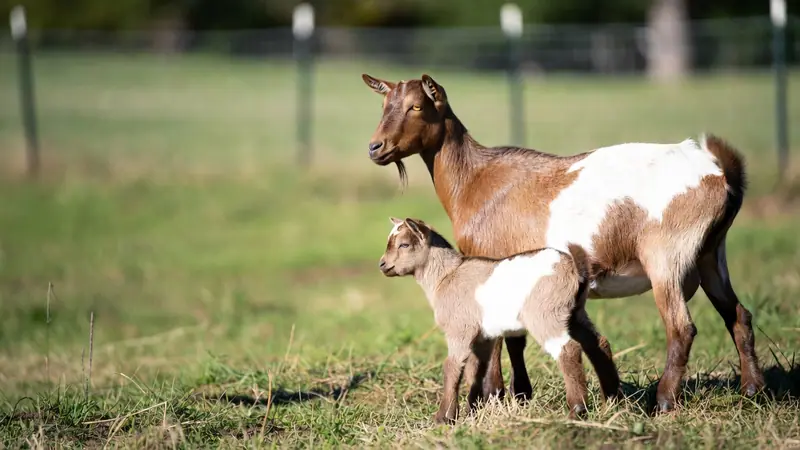
At a glance
- How long are goats pregnant?
- About 150 days, or roughly five months. Most does kid 145–155 days after breeding (Merck Veterinary Manual). Read more about how long are goats pregnant
- How do I work out a goat's due date?
- Add about 150 days to the breeding date. A doe bred on October 1, 2026 is due around February 28, 2027. Read more about how do i work out a goat's due date
- How long are Nigerian Dwarf goats pregnant?
- 145 to 153 days, according to the Nigerian Dwarf Goat Association. Read more about how long are nigerian dwarf goats pregnant
- How can I tell if my goat is pregnant?
- The first clue is a doe that does not come back into heat. A blood test can detect pregnancy from about 25 days after breeding, and ultrasound from about 30 days, most accurately after 45 days (Merck Veterinary Manual). Read more about how can i tell if my goat is pregnant
- When should I help a doe that is kidding?
- Contact your veterinarian if she strains hard for more than 30 minutes, or sooner if you suspect a problem. Read more about when should i help a doe that is kidding
Goat due date calculator
This goat pregnancy calculator counts from the day the doe was bred. Enter that date and choose a gestation length. If your breed is not listed, use the figure for goats in general or enter your own.
This is an average-based planning estimate, not confirmation of pregnancy or a guaranteed delivery date.
Goat gestation calendar and chart for a breeding season
If the buck runs with the does for several weeks, a calendar shows when kids could arrive from each week of breeding. Enter the first day and the length of the season.
How long are goats pregnant, by breed?
The gestation period for goats is about 150 days. The figures below come from veterinary and breed references. The cited planning figures differ by about a day. The Nigerian Dwarf setting uses the midpoint of a published range, not a measured mean; individual gestations can vary.
| Goats | Gestation | Source |
|---|---|---|
| Goats in general | 145–155 days, average 150 | Merck Veterinary Manual |
| Meat goats | 146–155 days, about 150 | Oklahoma State University |
| Boer | Average 150 days | American Boer Goat Association |
| Dairy goats | 145–155 days, average 149 | Penn State Extension |
| Nigerian Dwarf | 145–153 days | Nigerian Dwarf Goat Association |

How to tell if a goat is pregnant
The first clue is a doe that does not come back into heat after breeding. To confirm it, the Merck Veterinary Manual describes two tests. A blood test for pregnancy-specific protein B can detect pregnancy from about 25 days after breeding, although it can read falsely positive if a fetus died within the last 15 days. Ultrasound is the gold standard: through the abdomen it can find a pregnancy as early as 30 days and is most accurate after 45 days. Merck does not recommend progesterone tests because of low accuracy: high progesterone cannot separate pregnancy from pseudopregnancy, a condition where fluid collects in the uterus.
Using the date: from breeding to kidding
Use the estimated date to plan care with your veterinarian. Dewormer safety depends on the product, stage of pregnancy, local approval and the doe's condition; do not use a blanket calendar rule to select or withhold treatment. Ask your veterinarian which products and timing are appropriate. For example, US albendazole restrictions are product-specific, not a rule for every dewormer worldwide. Oklahoma State University describes tetanus and enterotoxemia revaccination two to four weeks before kidding; confirm the product label and individual plan with your veterinarian.
If a doe was bred and comes back into heat, she probably did not settle. Goats cycle every 18–22 days (Oklahoma State University), so watch for signs such as tail wagging and bleating about three weeks after breeding, and recalculate from the new date if she is bred again.
Mucous discharge can be a sign that kidding is approaching, but it does not establish an exact delivery time (Oklahoma State University). Kids should get colostrum within the first hour after birth, and certainly within the first six hours, because its antibodies fall quickly after kidding.
For other species, see the sheep gestation calculator and the cow gestation calculator.
Frequently asked questions
How long are goats pregnant?
About 150 days, or roughly five months. The Merck Veterinary Manual gives 145–155 days, and Oklahoma State University gives 146–155 days.
What changes the goat gestation period?
The Merck Veterinary Manual lists breed, litter weight, environment and parity, which is the number of times the doe has kidded.
How long are Nigerian Dwarf goats pregnant?
Nigerian Dwarfs are miniature dairy goats, and the Nigerian Dwarf Goat Association gives 145 to 153 days. The low end matches the Merck range for goats in general, and the high end is two days earlier.
How long does a doe take to kid?
Oklahoma State University describes three stages. Preparation lasts 4–8 hours in mature does and 6–12 hours in first-time mothers. Delivery should take under an hour in mature does and up to 4 hours in first-time mothers. Passing the afterbirth takes 1–8 hours.
When should I help a doe that is kidding?
Contact your veterinarian if she strains hard for more than 30 minutes, or sooner if you suspect a problem. Ask for professional guidance rather than attempting to reposition or pull a kid without appropriate training.
Sources
- Merck Veterinary Manual. Pregnancy in goats. 145–155 days, average 150; what affects it
- Montague M. Kidding. Chapter 8, meat goat production program, Oklahoma State University Extension. 146–155 days, stages of kidding, when to assist, deworming and colostrum timing, estrous cycle
- Merck Veterinary Manual. Pregnancy determination in goats. Blood test, ultrasound, progesterone, pseudopregnancy
- Penn State Extension. Dairy goat production. 145–155 days, average 149
- American Boer Goat Association. Gestation calculator. Boer goats average 150 days
- Nigerian Dwarf Goat Association. Breeding. 145–153 days
- Nigerian Dwarf Goat Association. Nigerian Dwarf goats: colorful, miniature dairy goats of West African origin (brochure)
This page is general education, not a diagnosis or prescription. Always confirm doses and treatment with your veterinarian.