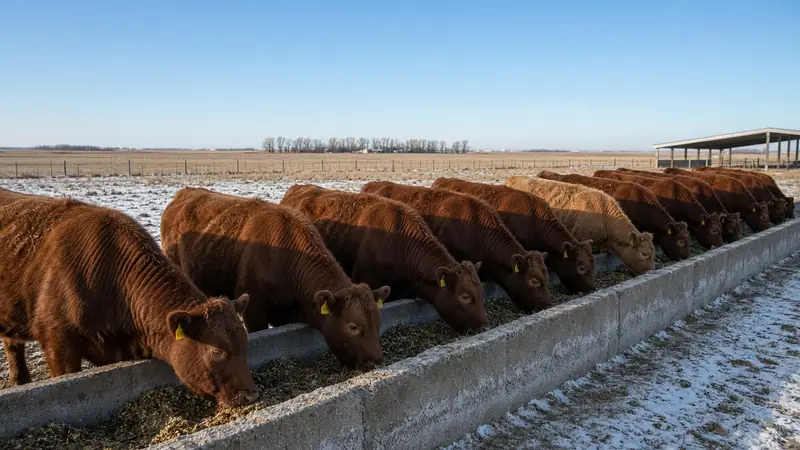
This case study summarizes our published work in Gene, volume 936 (2025), article 149082, published online on 12 November 2024. Read the full paper: https://doi.org/10.1016/j.gene.2024.149082
Highlights
- Heifers
- 36crossbred Angus, about 13 months old
- Daily gain (kg)
- 0.28 vs 0.79low vs moderate, first 83 days
- Fetal liver sampled
- Day 83female fetuses only
- Omics layers
- 3methylome, microRNAs, transcriptome
- Heifers fed for moderate gain carried fetuses whose livers differed from those of low-gain heifers in DNA methylation and in one microRNA.
- Eight genes were differentially methylated (five hypermethylated, three hypomethylated), tied to Wnt, mTOR and Hippo signaling and to transcription control.
- Only one microRNA changed: bta-miR-206, about four times higher in moderate-gain fetuses. Its 809 predicted target genes point to embryonic development, energy metabolism and mineral transport.
- Twenty-nine of those targets were also among the 381 genes already known to change in these livers, and most of them were up-regulated.
Methodology
The first weeks of pregnancy are when the placenta forms and organs such as the liver begin to develop, and the dam's diet during that window can shift how the fetus grows. Earlier work from this cattle model showed that the dam's rate of weight gain changed fetal liver weight, mineral reserves and gene expression. This study asked what controls those gene changes, looking at two regulators of gene activity: DNA methylation and microRNAs.
Crossbred Angus heifers of about 13 months were bred by artificial insemination and fed to gain either 0.28 kg a day (low gain, LG) or 0.79 kg a day (moderate gain, MG). The larger trial also tested vitamin and mineral supplementation; this study used only fetuses from supplemented dams, so the comparison isolates the rate of gain.
Study timeline
- Breeding Two rates of gain LG 0.28 kg/day or MG 0.79 kg/day, after estrus synchronization and AI
- Day 35 Pregnancy confirmed Transrectal ultrasound
- Day 60 Fetal sex identified Heifers carrying female fetuses continued
- Day 83 Fetal liver collected 15 livers passed quality control (LG 8, MG 7)
Each liver sample was read three ways, and the three layers were then compared with each other.
Three layers of the same livers
DNA methylation
- Method
- Reduced representation bisulfite sequencing (RRBS), about 20 M reads per sample
- Analysis
- Bismark, then methylKit for differentially methylated regions (FDR < 0.1)
MicroRNAs
- Method
- Small RNA sequencing, about 10 M reads per sample
- Analysis
- miRDeep2 and edgeR (FDR < 0.05); targets predicted with TargetScan
Gene expression
- Source
- RNA-seq from the same fetuses, reported earlier
- Used here
- 381 genes differing between MG and LG
Both differential analyses corrected for the farm each heifer came from. Gene lists were tested for over-represented pathways with g:Profiler, and correlations between the layers were checked with Spearman rank correlation.
Results
The two feeding levels produced different dams. Moderate-gain heifers ended heavier, while their fetuses did not differ in body weight. Relative to fetal body weight, though, the liver was heavier in low-gain fetuses.
Dam final body weight (kg)
Fetal liver weight (% of fetal body weight)
DNA methylation differed at eight regions, each mapping to one gene. Five were hypermethylated in moderate-gain fetuses and three were hypomethylated.
The eight differentially methylated genes
- 5 of 8 genes · hypermethylated HIP1R · POU2F2 · CAPZB · WNT7B · one unnamed transcript · pathways: Wnt, mTOR and Hippo signaling, endocytosis, lipid and atherosclerosis
- 3 of 8 genes · hypomethylated HSPBP1 · two unnamed transcripts · assembly of the transcription preinitiation complex; protein processing in the endoplasmic reticulum
Among microRNAs, only bta-miR-206 changed, about four-fold higher in moderate-gain fetuses (FDR = 0.02). TargetScan predicted 809 genes it could regulate, enriched for embryonic development, angiogenesis, muscle development and calcium and zinc transport, and for the AMPK, cAMP, MAPK, mTOR, PI3K-Akt and Wnt signaling pathways.
Linking the microRNA to genes that actually changed
- miRNAome 809 predicted targets Genes bta-miR-206 could regulate
- Transcriptome 381 changed genes Already reported for MG vs LG
- Overlap 29 genes in both 23 up-regulated, 6 down-regulated in MG
The 29 shared genes were enriched for lipid metabolism (including ABCA1 and FADS1), osteoblast development (JUND), cartilage development (SOX6), PI3K-Akt signaling and negative regulation of MET activity. No microRNA–gene pair was significantly correlated after correction, and no gene was both differentially methylated and differentially expressed. Methylation of promoter CpGs did, however, correlate with expression for seven genes (r² about 0.97, FDR < 0.1), among them the zinc transporter SLC39A5, with links to metal ion transport and the GTPase cycle.
Discussion
This is the first study to combine the methylome and microRNA data with the transcriptome to ask how a dam's rate of gain in early pregnancy reprograms the fetal liver in cattle. The layers did not line up gene for gene, but they pointed to the same processes: nutrient sensing, lipid metabolism and organ development. Other regulators, such as histone changes and long non-coding RNAs, may account for the rest; our related work on long non-coding RNAs in the fetal liver is listed in the references below.
The CpG results tie back to minerals. Low-gain fetuses stored more manganese and molybdenum in the liver in earlier work on this model, and the CpG-linked genes here relate to metal ion transport, which suggests methylation helps regulate those reserves.
bta-miR-206 is best known as a muscle microRNA, so its higher level in the fetal liver points to a role in liver development too. MicroRNAs usually turn genes down, yet most of its overlapping targets were up-regulated, and the shared genes pointed to bone and cartilage development and to MET signaling, which the authors connect to the heavier livers of low-gain fetuses. The paper is careful here: the number of methylated genes was small, and the findings need validation and follow-up after birth. For how early maternal diet also changes fetal mitochondria, see our maternal nutrition and fetal mitochondria case study.
Conclusion
- A heifer's rate of weight gain in the first 83 days of pregnancy changed DNA methylation at eight genes and the level of one microRNA, bta-miR-206, in the fetal liver.
- bta-miR-206 targets 29 genes that also changed in expression, linked to lipid metabolism, bone and cartilage development and MET signaling.
- Methylation and microRNAs pointed to the same pathways as the transcriptome, even without gene-by-gene overlap.
- Whether these changes persist after birth, or into the next generation, still has to be tested.
Key References
- Anas M, Ward AK, McCarthy KL, Borowicz PP, Reynolds LP, Caton JS, Dahlen CR, Diniz WJS (2024). lncRNA-gene network analysis reveals the effects of early maternal nutrition on mineral homeostasis and energy metabolism in the fetal liver transcriptome of beef heifers. Journal of Nutritional Biochemistry, 109691. https://doi.org/10.1016/j.jnutbio.2024.109691
- Anas M, Diniz WJS, Menezes ACB, Reynolds LP, Caton JS, Dahlen CR, Ward AK (2023). Maternal mineral nutrition regulates fetal genomic programming in cattle: a review. Metabolites, 13, 593. https://doi.org/10.3390/metabo13050593
- Diniz WJS, Ward AK, McCarthy KL, Kassetas CJ, Baumgaertner F, Reynolds LP, et al. (2023). Periconceptual maternal nutrition affects fetal liver programming of energy- and lipid-related genes. Animals, 13, 600. https://doi.org/10.3390/ani13040600
- Menezes ACB, McCarthy KL, Kassetas CJ, Baumgaertner F, Kirsch JD, Dorsam ST, et al. (2022). Vitamin and mineral supplementation and rate of gain in beef heifers I: effects on dam hormonal and metabolic status, fetal tissue and organ mass, and concentration of glucose and fructose in fetal fluids at d 83 of gestation. Animals, 12, 1757. https://doi.org/10.3390/ani12141757
- Crouse MS, Caton JS, Cushman RA, McLean KJ, Dahlen CR, Borowicz PP, Reynolds LP, Ward AK (2019). Moderate nutrient restriction of beef heifers alters expression of genes associated with tissue metabolism, accretion, and function in fetal liver, muscle, and cerebrum by day 50 of gestation. Translational Animal Science, 3, 855–866. https://doi.org/10.1093/tas/txz026